Openhand Press
Grizzly Sessions
Grizzly — Owl’s House, West Pennant, Nova Scotia
Lat/Lon: 44.47880, -63.63344
FA: Nick Sagar, 2006
Session 1 — Tuesday, March 3, 2026
Conditions: ~90% humidity, 1 / -4 °C, windy
It was cold. Bitter cold.
But the rock was dry.
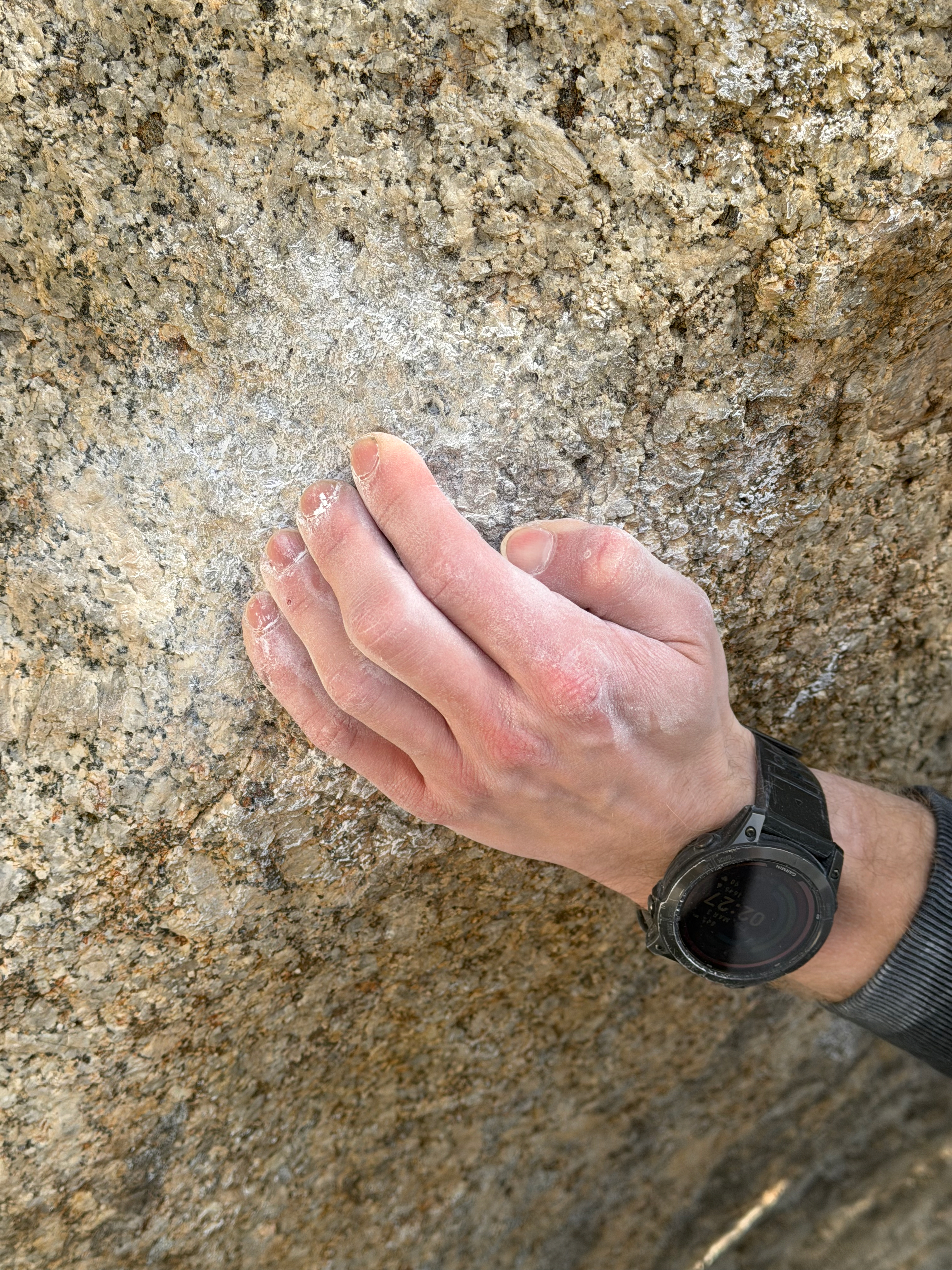
Tommy and I went out after school to Owl’s House in West Pennant to take a look at Grizzly, a compression test piece first climbed by Nick Sagar in 2006.
I had avoided trying it for a long time. Wide compression is not my strength, but out of all the problems in the area, Grizzly always stood out as the most inspiring, the kind of line that feels worth trying even if it exposes a weakness.
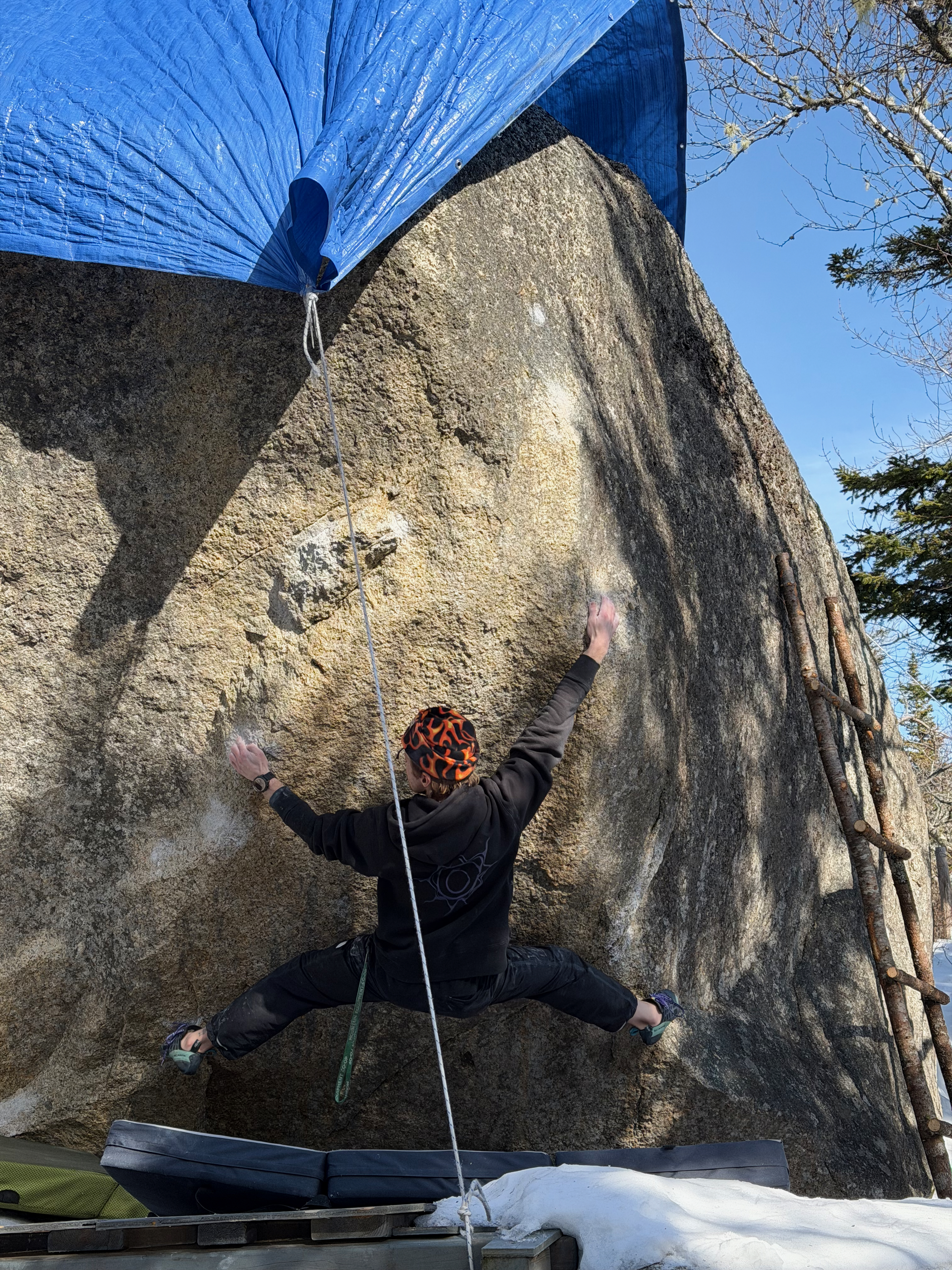
I blew the flash burn on the crux first move, as expected, and started working the problem under the tarp. The tarp wasn’t ours, so we left it as we found it and focused on figuring out the moves instead of messing with the setup.
From about three moves in, I could do the rest of the problem, but the opening sequence quickly became the clear crux.
You start already in a wide position, deadpoint to a decent sloper, bump again to a better left hand, then set a very high heel and reach right to a semi-decent sloping hold. The movement feels powerful but also awkward, the kind of compression where every inch matters.
Last try of the session, hands numb and feet starting to lose feeling:
I never managed to complete the heel-hook sequence into the first right-hand move, but sticking the opening deadpoint gave me confidence that the boulder might be possible for me.
We called it when the cold started winning.
Session 2 — Monday, March 9, 2026
Conditions: ~70% humidity, 4 / -3 °C, light wind
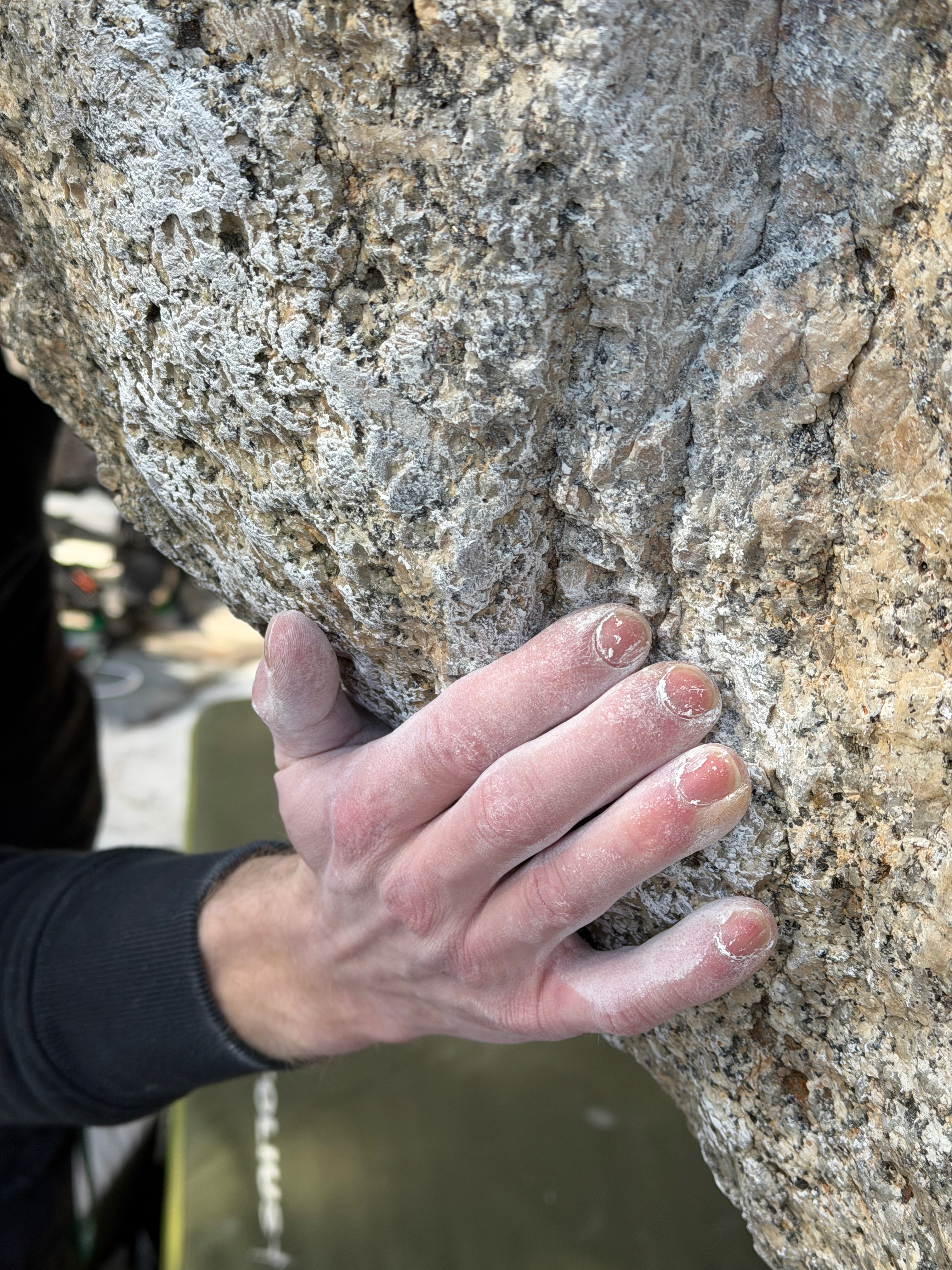
A week later, Tommy and I went back to the Owl’s House deck.
A couple other crews were out as well, working different problems on the boulder.
The difference in conditions was obvious right away.
Still cold, but not biting.
Less wind, warmer rock, and I could actually feel my fingers.
I stuck the first move quickly, bumped through the second, and started dialing the heel-hook / kneebar options for the first right-hand move. After trying a few variations, I settled on the heel-hook method. With some help from Evan on the placement, I finally unlocked the sequence.
Now it was time to try from the start.
I had two strong attempts, both ending the same way — heel slipping after the crux, just a few moves before the top-out.
Both times I made it cleanly through the hard climbing and fell on the third-to-last hold before the top-out.
I ended the session early to save skin.
I was scheduled for a setting day later that week, and I didn’t want to blow the chance at the next good weather window.
Session 3 — Thursday, April 2, 2026
Conditions: ~90% humidity, 5 / -1 °C, moderate wind
I wanted to get on rock so badly after the miserable freezing rain and snowstorms kept me away from Grizzly since Session 2 that I went the day after a setting day, with my skin already slightly fried. This was my first real chance to get back on the moves, and I could feel the time off right away.
Regardless, I went in with no expectations—just wanting to repeat moves and dial in my current beta.
It was a cold day at Owl’s House. Even with winter gloves, a buddy heater, hand warmers, and good vibes from Tyler and Evan, it never really warmed up.
My first attempt from the ground ended up being my best of the day. I came into the move to the shark tooth feeling fresh, but dry fired off the left-hand undercling—it was too glassy in the conditions to properly engage.
Unfortunately, I split my left index, and with already limited skin, I was running on fumes.
One useful discovery from the session was that I could still repeat the opening sequence with a taped index, matching my high point from the first burn.
With warmer conditions in the forecast, it felt like things were lining up for a real attempt.
Session 4 — Monday, April 6, 2026
Conditions: ~90% humidity, 6 / 0 °C, light wind
Back at Owl’s House with Tyler and Evan around 2pm, the difference in conditions was obvious right away. The sun was directly on the line.
While it felt too cold in the previous session, this one felt almost too warm. With the sun on the slopers, any inaccuracy was incredibly punishing—missing the right part of a hold meant eviscerated skin. The rock felt warm to the touch, and skin wore down quickly.
I started the session with tape on my fingers, but quickly realized the top-out was much more difficult that way, especially for the left-hand move to the lip, and ended up removing it.
I managed to make it to the shark tooth move four or five times and reached a new high point, sticking the shark tooth and making the left-hand throw to the lip, beginning the top-out process. The movement felt controlled, like I had margin, and the left-hand throw felt solid.
On my best attempt, I tried to follow the typical beta—throwing to the right-hand crimp off the heel—but fell short, not quite having the distance to reach it.
After that, I took time to refine and rehearse the top-out sequence. Instead of relying on the heel, I switched to a higher foot, which put me in a much better position to throw to the right-hand crimp and begin working through the final moves.
This failed send attempt felt important for two reasons. First, it took the edge off the fear of blowing it on a ground-up attempt. Second, it made it clear that the final right-hand move to the crimp is no joke, and will likely end up being the true redpoint crux.
My skin still hadn’t fully recovered from the previous session, and with warmer conditions, the margin felt smaller. Still, chasing the right conditions, it feels like the send is there for the next session.
Working Beta
Left foot in the right-most ledge foothold — careful not to dab the block with the ankle.
Right foot on the vertical chip. Keep weight over the left side so the right arm stays extended.
Throw left hand as if standing into the compression.
Weight the left foot, flag right, bump left hand to the better sloper.
Adjust right hand into the good part of the undercling.
Squeeze in, set heel a few inches under the right hand, then go right to the sloper.
Shift weight centered.
Toe-scum the left start hold.
Switch heel to toe-scum, deadpoint left hand to the crimp on the flake.
High left foot to the good foothold.
Right toe-hook under the undercling.
Static right hand to the higher sloper with the thumb catch.
Set the delicate right heel.
Flip left hand into the undercling.
Deadpoint right to the shark-tooth.
Pop left hand to lip, expect feet to cut. Right high foot, keep left foot off the wall. Right hand deadpoint to rounded crimp. Take a second to reset.
Then the top-out begins.
Next session plan
Dial the top-out with the higher foot beta, wait for cold but not too warm conditions, and commit to a full ground-up redpoint attempt.